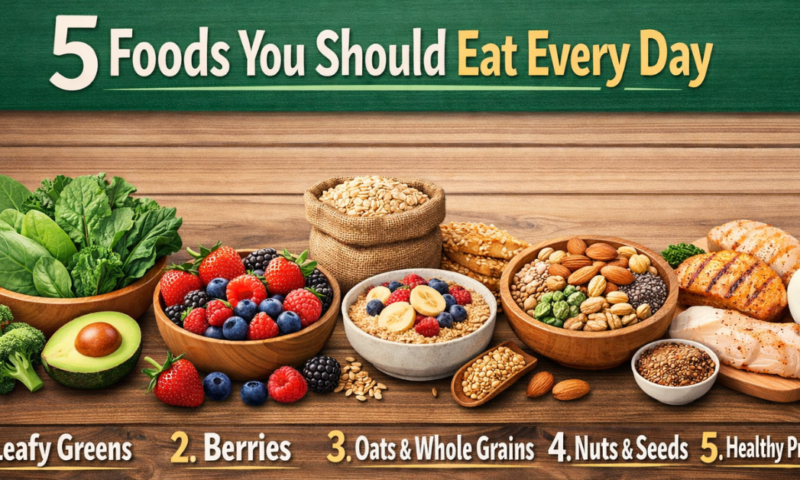
What are the healthiest foods to eat every day? Based on the most consistent evidence across Harvard Health, Mayo Clinic, the WHO, and the 2025–2030 US Dietary Guidelines, the five healthiest foods to eat daily are: blueberries, dark leafy greens (spinach, kale), nuts, fatty fish (salmon, sardines), and eggs. These five appear repeatedly across independent research for delivering measurable benefits to the brain, heart, bones, eyes, and metabolism simultaneously.
✓ Harvard Health
✓ Mayo Clinic
✓ WHO Guidelines
✓ 2025 Research
Nutrition science is often frustratingly contradictory. Coffee is good, then bad, then good again. Eggs cause heart disease, then they do not. Fat is the enemy until it is not. Against this backdrop of constant revision, it is tempting to eat whatever you want and ignore the noise entirely.
But underneath the noise, there is a remarkably consistent body of research pointing to a small group of foods that appear again and again across independent studies, dietary guidelines, and long-term population research. This is not a list of trendy superfoods that claim to cure everything. It is a list of foods with the strongest, most consistent scientific backing for daily consumption — and what actually happens to your body when you eat them regularly.
5 Healthiest Foods to Eat Daily: Quick Science Overview
Here is the complete overview before diving into each food in detail — what each contains, what it protects against, and how quickly research suggests you may notice a difference:
| # | Food | Key Nutrients | Primary Benefits | Endorsed By |
|---|---|---|---|---|
| 1 | 🫐 Blueberries | Anthocyanins, Vit C, K, fibre | Brain health, heart health, anti-ageing | Harvard, Mayo Clinic |
| 2 | 🥬 Leafy Greens | Vit A, C, K, folate, calcium, iron | Bone health, vision, cognitive decline prevention | Harvard, CDC, WHO |
| 3 | 🌰 Nuts | Healthy fats, Vit E, magnesium, fibre | Heart health, reduced LDL, brain function | Harvard, Mayo Clinic |
| 4 | 🐟 Fatty Fish | Omega-3 (EPA & DHA), protein, Vit D, B12 | Heart, brain, joint and mood health | Harvard, Mayo Clinic, WHO |
| 5 | 🥚 Eggs | Choline, protein, Vit D, selenium, B vitamins | Brain health, muscle maintenance, eye health | Harvard, Mayo Clinic |
Blueberries — The Brain’s Best Friend
Of all the healthiest foods to eat daily, blueberries may have the most impressive scientific credentials for brain health specifically. A 2019 review of 16 studies found that regular blueberry consumption may help protect against cognitive decline and reduce the risk of Alzheimer’s disease. A 2010 study in the Journal of Agricultural and Food Chemistry found that older adults who consumed blueberry juice daily improved memory function within just 12 weeks.
The reason is anthocyanins — the pigments that give blueberries their deep blue-purple colour. These powerful antioxidants reduce oxidative stress and inflammation in the brain, improve blood flow to key cognitive regions, and strengthen communication between brain cells. Harvard Health calls blueberries one of its top superfoods, and Mayo Clinic specifically highlights their anthocyanins as being “linked to memory health, among other benefits.”
- ✓Reduces oxidative stress and inflammation in the brain — directly linked to Alzheimer’s and dementia prevention
- ✓Linked to reduced cardiovascular disease risk and improved blood pressure markers
- ✓Supports improved gut microbiome diversity — increasingly linked to whole-body health outcomes
- ✓Associated with reduced metabolic risk factors and improved insulin sensitivity
Leafy Greens — The Most Nutrient-Dense Category on Earth
No single category of food appears more consistently across every major dietary guideline and nutrition research body than dark leafy greens. The 2025–2030 US Dietary Guidelines recommend three servings of vegetables daily, with leafy greens singled out as a priority. The WHO, CDC, Harvard T.H. Chan School of Public Health, and virtually every nutrition authority on the planet agree: eating more leafy greens is one of the most impactful dietary changes most people can make.
The category includes spinach, kale, Swiss chard, collard greens, arugula, and romaine. They are among the most nutrient-dense foods per calorie on earth — delivering vitamins A, C, K, folate, calcium, and iron with almost no caloric cost. Northwestern Medicine identifies leafy greens as essential for slowing cognitive decline specifically, noting they are “full of nutrients that help protect brain cells from harmful free radicals.”
Nuts — Heart Health in a Small Package
Nuts are one of the most research-validated foods for daily consumption, with Harvard Health, Mayo Clinic, and the Mediterranean diet — arguably the most evidence-backed dietary pattern in the world — all strongly endorsing a daily handful. The consistent finding across decades of studies: regular nut consumption is associated with reduced LDL (bad) cholesterol, lower cardiovascular disease risk, reduced inflammation, and improved longevity.
The mechanism is primarily their fat profile. Nuts are rich in monounsaturated and polyunsaturated fatty acids — the same types found in olive oil — which replace saturated fats and directly improve heart health markers. Walnuts stand out specifically for brain health, containing some of the highest plant-based omega-3 levels available. Harvard Health caution: “They are calorically dense, so limit to a small handful.”
Fatty Fish — The Omega-3 Powerhouse
Fatty fish — salmon, sardines, mackerel, trout, herring — are the richest dietary source of EPA and DHA omega-3 fatty acids, two specific long-chain fats that the human body cannot efficiently synthesize on its own. These are the omega-3s that matter most for health outcomes, found at meaningful concentrations almost exclusively in fatty fish and algae.
The research supporting regular fatty fish consumption is among the most robust in nutritional science. EPA and DHA are strongly linked to reduced cardiovascular disease risk, lower blood triglycerides, reduced systemic inflammation, and improved brain function across all age groups. Mayo Clinic notes that salmon’s omega-3s “may support heart health, brain function and healthy joints.” The 2025–2030 US Dietary Guidelines recommend at least 8 ounces of seafood per week — roughly two meals.
| Fish | Omega-3 Level | Mercury Risk | Cost | Best For |
|---|---|---|---|---|
| 🐟 Salmon | Very High | Low | Moderate–High | Overall best option |
| 🐟 Sardines | Very High | Very Low | Very Low | Best value, canned, daily |
| 🐟 Mackerel | Very High | Moderate | Low | European Atlantic variety best |
| 🐟 Trout | High | Very Low | Moderate | Mild flavour, easy for beginners |
Eggs — The Most Complete Single Food
Eggs spent decades as a nutritional villain, blamed for cardiovascular disease because of their cholesterol content. The scientific consensus has since shifted significantly. A 2017 review in Food & Nutrition Research concluded that eggs do not meaningfully increase cardiovascular disease risk in healthy people, and Harvard Health now includes eggs in its list of superfoods — noting their exceptional nutrient density.
The case for eggs rests on their extraordinary nutritional completeness. A single large egg contains complete protein (all essential amino acids), choline — a critical nutrient for brain function most people are chronically deficient in — Vitamin D (rare in foods), Vitamin B12, selenium, and the antioxidants lutein and zeaxanthin, which protect against age-related macular degeneration.
Most adults are chronically deficient in choline — and eggs are the simplest fix
Choline is the precursor to acetylcholine, a neurotransmitter essential for memory, muscle control, and cognitive function. Northwestern Medicine highlights choline-rich foods as important for cognitive health. Most dietary surveys show the majority of adults consume significantly less choline than recommended. Eggs are the most accessible, affordable, and concentrated dietary source of choline available. A single egg delivers approximately 147mg — over a quarter of the daily adequate intake for adults.
How to Fit All 5 Into Your Day: A Simple Meal Plan
The common objection to eating all five healthiest foods daily is that it feels complicated. It is not. Here is how all five fit naturally into a single ordinary day:
| Meal | Food Included | How It Looks | Prep Time |
|---|---|---|---|
| Breakfast | 🥚 Eggs + 🫐 Blueberries | Scrambled eggs + Greek yogurt with blueberries on the side | 5 minutes |
| Mid-morning | 🌰 Nuts | Small handful of mixed walnuts and almonds as a snack | 0 minutes |
| Lunch | 🥬 Leafy Greens + 🌰 Nuts | Large spinach or kale salad with toasted almonds and olive oil | 3–5 minutes |
| Dinner | 🐟 Fatty Fish + 🥬 Greens | Baked salmon with wilted spinach or steamed broccoli | 20 minutes |
| Smoothie Option | All 5 in one drink | Blueberries + spinach + Greek yogurt + walnuts (blended — greens tasteless) | 3 minutes |
Full Nutrient Breakdown Per Serving
| Food | Serving | Calories | Key Vitamins | Standout Compound | Top Health Benefit |
|---|---|---|---|---|---|
| 🫐 Blueberries | ½ cup (74g) | ~42 | C, K, manganese | Anthocyanins | Brain & heart protection |
| 🥬 Spinach (raw) | 2 cups (60g) | ~14 | A, C, K, folate, iron | Lutein & zeaxanthin | Vision, bones, cognition |
| 🌰 Mixed Nuts | 1 oz (28g) | ~170 | E, magnesium, folate | Monounsaturated fats | Heart health, LDL reduction |
| 🐟 Salmon | 3 oz (85g) | ~177 | D, B12, selenium | EPA & DHA omega-3s | Heart, brain & mood |
| 🥚 Egg (1 large) | 1 egg (50g) | ~72 | D, B12, selenium | Choline (147mg) | Brain function & muscle |
Frequently Asked Questions
The science behind these five foods is not speculative or trendy. It is among the most replicated, most peer-reviewed, most broadly endorsed nutrition evidence available. Harvard, Mayo Clinic, the WHO, and the CDC all point in the same direction.
Start with one. Add the next when the first feels automatic. The compound health returns arrive quietly — over weeks and months — in the form of energy you did not expect, focus you thought you had lost, and resilience that surprises you.
We are not medical professionals, registered dietitians, or nutrition experts. The content in this article is compiled from publicly available research, published dietary guidelines, and respected health institutions (Harvard Health, Mayo Clinic, WHO, CDC) for general informational and educational purposes only. It does not constitute medical or nutritional advice, diagnosis, or treatment.
Individual health needs vary significantly based on age, health conditions, medications, allergies, and personal circumstances. Always consult your doctor or a registered dietitian before making significant changes to your diet — especially if you have existing health conditions, take medication, are pregnant or breastfeeding, or have concerns about specific foods.
We have made every effort to present accurate, up-to-date information — but nutrition science evolves constantly, and individual studies do not always represent scientific consensus. The goal of this article is to share what the current body of evidence suggests, not to make personal health recommendations.
Are you a registered dietitian, nutritionist, or healthcare professional? We welcome expert input, corrections, and additions to this content. Reach out via our contact page — we are always open to improving the accuracy and depth of our health content with professional guidance.





Leave a Reply