
Five hundred dollars a month sounds modest. But for most people, it means a car payment taken care of, a month of groceries covered, or the first real chunk of savings sitting in an account. It changes the feeling of a month.
The reason this number matters is not the amount itself, it is what it proves. Once you consistently make $500 using AI tools, you understand the machine. You know what works, what clients want, and what to scale. The first $500 is the hardest. After that, it compounds.
This guide is not theory. It is built on what real freelancers, bloggers, and small service providers are doing right now to earn with AI — starting from zero, with free tools, in realistic time frames.
Let’s go method by method.
Earnings Disclaimer: The income figures mentioned in this article are estimates based on publicly available platform data, freelancer reports, and industry surveys. Results vary significantly based on effort, skill level, niche, and market conditions. We are not financial advisors or income guarantee experts. This content is for informational and educational purposes only. Do not treat any figures here as a promise or guarantee of earnings.
Why 2026 Is the Best Time to Start Earning With AI
Before the methods, it helps to understand why the window is open right now.
According to Upwork’s 2025 Freelancer Impact Report, demand for AI-assisted writing, content, and automation services on the platform grew over 60% year-on-year. Meanwhile, a 2025 McKinsey Global Survey found that over 65% of businesses are now regularly using generative AI in at least one function — up from 33% just a year earlier.
The gap between demand and supply is still wide. Most small businesses know they need AI-generated content, social captions, or basic automation. Very few of them have someone doing it well for them yet. That is your opening.
You do not need to be first. You need to be consistent, competent, and easy to work with.
7 Methods to Make Money With AI Online in 2026
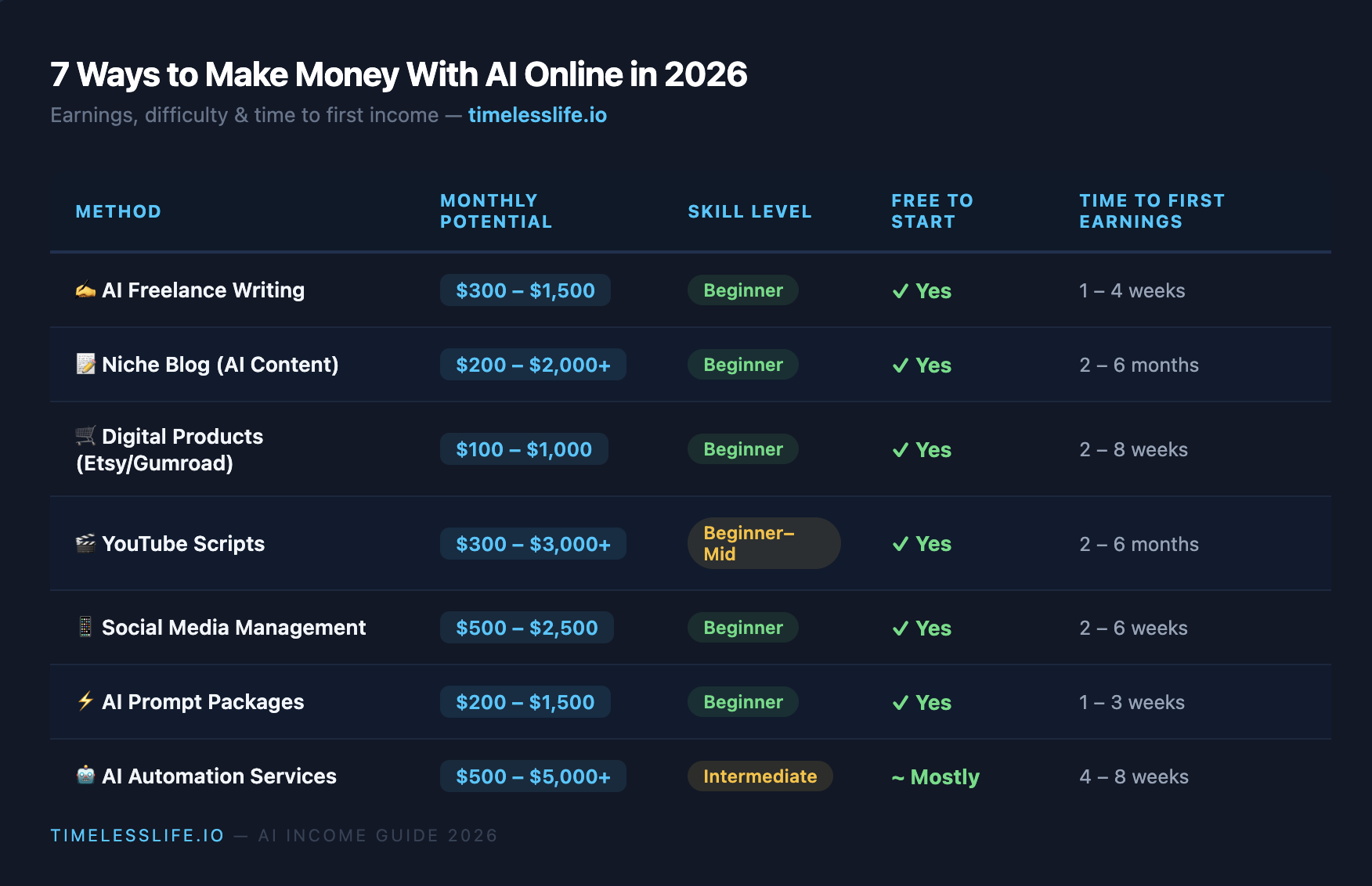
Method 1: AI-Assisted Freelance Writing — The Fastest Way to $500
This is where most people should start. Not because it is the most exciting, but because it is the most direct route from zero to paid.
The model is simple. A client needs a 1,500-word blog post. You use ChatGPT or Claude to generate a strong first draft in under 10 minutes. You spend another 30 to 45 minutes editing for accuracy, adding your own examples, restructuring the flow, and matching the client’s tone. You deliver a polished article. You charge $50 to $100. The client does not know — and does not need to know — how fast the draft came together. They are paying for quality output, not your process.
Where to find clients:
- Fiverr — Create a gig in the “Article & Blog Posts” category. New sellers can price at $25–$50 to build reviews fast, then raise rates. Many established writers on Fiverr earn $500–$2,000/month from repeat buyers alone.
- Upwork — Better for longer-term contracts. Search for “blog writer” or “content writer” and submit targeted proposals. Your pitch matters more than your profile initially.
- PeoplePerHour — Strong UK and European client base. Less saturated than Upwork for new writers.
- LinkedIn — Post about your writing service weekly. Direct message marketing managers at small businesses. One warm lead from LinkedIn is worth ten cold Fiverr inquiries.
Realistic earnings breakdown:
- Month 1: 6–10 articles at $25–$40 = $150–$400 (building reviews, refining workflow)
- Month 2–3: Repeat clients, rate increase to $50–$75 = $400–$750/month
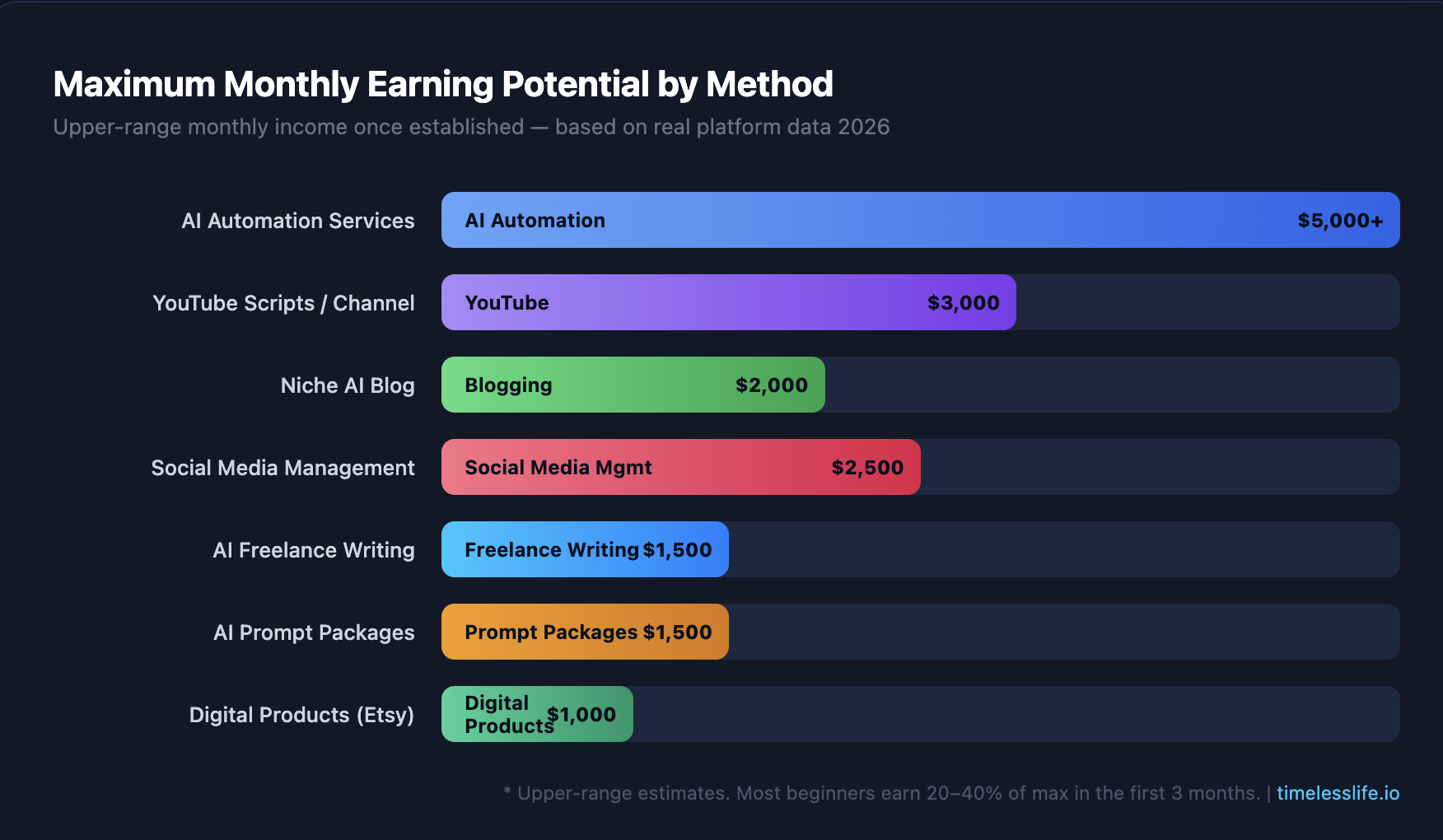
- Month 4+: Specialised niche + $75–$150 per article = $800–$1,500/month
The niche shortcut: Writers who specialise earn more and faster. Instead of “freelance writer,” become the writer for SaaS product blogs, or the writer for real estate agencies, or the writer for personal finance newsletters. Niche positioning triples your perceived value overnight.
Free tools to use: ChatGPT Free, Claude Free, Grammarly Free (for proofreading), Hemingway Editor (readability).
Method 2: Start a Niche Blog Powered by AI — Slow Burn, Big Payoff
Blogging with AI is not a get-rich-fast strategy. It is a get-rich-patient strategy — and it genuinely works for people who stick with it.
The core model: you use AI to help research, outline, and draft blog content significantly faster than writing from scratch. Instead of publishing two articles a month, you publish eight to twelve. Instead of spending six hours on one post, you spend ninety minutes. The volume advantage compounds over time through SEO.
What makes a niche blog succeed in 2026:
Generic lifestyle blogs and “top 10 life hacks” sites are saturated beyond recovery. Specific audience blogs are not. A few real examples of underserved niches with genuine search demand:
- Personal finance for gig workers or rideshare drivers
- Nutrition advice for people over 50
- Productivity methods for remote workers with ADHD
- Home renovation tips for first-time buyers
- Travel guides for solo female travellers over 40
Each of these has a defined reader, real search volume (check with Google’s free Keyword Planner or Ubersuggest), and monetisation potential through affiliate products or display ads.
How monetisation works once traffic builds:
- Display ads via Google AdSense: Available from day one, but earnings are low until you reach 10,000+ monthly sessions. At that level, expect $300–$800/month depending on niche.
- Mediavine or Raptive (formerly AdThrive): Require 50,000+ sessions/month but pay significantly more — often $15–$40 RPM (revenue per thousand views).
- Affiliate marketing: Promote products relevant to your niche. Amazon Associates pays 1–10% commission. Niche-specific affiliate programmes (finance, software, health) often pay $20–$150 per conversion.
- Your own digital product: Once you have an audience, selling a $15–$49 guide or template is the highest-margin option.
Realistic timeline: 3–6 months to meaningful traffic (assuming 2–3 posts per week consistently). 6–12 months to $500/month from ads + affiliate alone.
This is not the fastest path to $500, but it is one of the few that can scale to $3,000–$10,000/month without proportionally more hours.
Method 3: Sell AI-Generated Digital Products on Etsy and Gumroad
Every other method in this guide requires ongoing work to earn. This one comes closest to genuine passive income — at least after the initial creation phase.
A digital product is something you build once and sell to hundreds of people. No shipping. No inventory. No customer service calls at midnight. You create it, list it, and let the platform’s search traffic find buyers.
Digital products that are selling well right now:
- Notion templates — Weekly planners, goal trackers, project management boards, client portals. Top Notion sellers on Gumroad report $500–$3,000/month from a bundle of 5–10 templates. Use ChatGPT to write all the page titles, instructions, and property descriptions inside the templates.
- Canva social media template packs — Businesses and creators constantly need fresh Instagram, LinkedIn, and Pinterest templates. A pack of 30 templates sells for $9–$25. Use Canva’s free plan to design; use ChatGPT to write the captions and text elements included in the pack.
- AI prompt packs — Collections of 20–50 expert-crafted prompts for a specific use case (e.g. “50 ChatGPT Prompts for Real Estate Agents” or “30 Claude Prompts for Email Marketing”). Price at $7–$19. Very low effort to create; high perceived value to buyers.
- Niche e-books and guides — A 3,000-word “Beginner’s Guide to Dog Training for Apartment Living” that solves a specific problem. Use ChatGPT to draft, you edit and add genuine insight. Sell for $9–$29.
- Resume and cover letter templates — Consistently among the highest-selling digital products on Etsy. Use AI to write optimised, ATS-friendly templates for different industries.
The platform breakdown:
- Etsy — Huge built-in buyer traffic. Listing fee is $0.20 per item. 6.5% transaction fee. Best for templates, printables, and planners.
- Gumroad — Better for guides, prompt packs, and e-books. Free to list; 10% platform fee on free plan, 0% on paid plans ($10/month). More flexibility for pricing and bundles.
- Creative Market — Premium design marketplace, better for Canva templates and graphic assets.
The maths to $500: Selling a $15 template pack to 34 people a month gets you there. With three to five products listed and basic SEO in your product titles, this is achievable within 6–10 weeks.
Method 4: Write YouTube Scripts — Ghostwriter or Faceless Creator
YouTube is the second-largest search engine on earth. People search for answers there the same way they search Google — and they increasingly prefer video. The earnings potential on YouTube is higher than almost any other method on this list. The barrier to entry is also lower than it seems.
Path A: Ghostwrite Scripts for Existing YouTubers
Thousands of creators with established audiences (50K–500K subscribers) outsource their scriptwriting because they are too busy to write consistently. They know their topic, their audience, and their style — but they need someone to turn an idea into a polished 1,500–3,000 word script each week.
Your process: client sends a topic and a few reference videos. You use ChatGPT or Claude to draft a script in their voice, then refine it. Deliver within 48 hours.
Find clients on Upwork (search “YouTube scriptwriter”), via cold outreach on Twitter/X to mid-size creators, or by posting your service on LinkedIn. Rates: $50–$150/script at entry level. At 4–6 scripts a month, you reach $200–$900. As you build a reputation with repeat clients, $150–$300/script is realistic.
Path B: Build a Faceless YouTube Channel
You never appear on camera. Use ChatGPT to write the script. Use a free text-to-speech tool (ElevenLabs free tier, or Murf AI) for narration. Use Canva or CapCut (both free) to assemble visuals.
Best-performing faceless YouTube niches in 2026: personal finance explainers, true crime, history breakdowns, tech news, book summaries, and self-improvement. These niches earn high CPM (cost per thousand views) from advertisers — often $8–$25 CPM compared to $2–$4 for entertainment content.
Revenue sources once monetised (1,000 subscribers + 4,000 watch hours):
- YouTube AdSense: $3–$25 per 1,000 views depending on niche
- Affiliate links in description: $20–$200/month per actively promoted product
- Sponsorships: Once you hit 10,000 subscribers, small sponsorships of $100–$500/video are accessible
Timeline: 3–6 months of consistent uploads (2–3 videos/week) to reach monetisation threshold.
Method 5: Offer AI-Powered Social Media Management to Small Businesses
Here is the hidden gem of this entire list. It is the method with the lowest barrier to entry, the fastest path to recurring income, and the highest demand from real local businesses.
The problem is universal: a local gym, restaurant, dental practice, or boutique clothing store knows they need to post on Instagram and Facebook consistently. Their engagement drops when they go quiet. But the owner is running the business — they have no time to think about captions, no idea what hashtags to use, and no budget for a full-time social media manager.
You can solve this problem in under two hours a week using AI — and charge $200–$500 per month per client.
What the service looks like:
- Use ChatGPT to generate a month’s worth of post captions in one session (30 minutes)
- Use Canva’s free templates to create branded graphics for each post (30–45 minutes)
- Deliver a content calendar with 12–16 posts, captions, and hashtags by the first of each month
- Optionally: schedule posts using Buffer free (10 posts/month on free plan) or Meta’s native scheduling
What to charge:
- Basic (8 posts/month, captions only): $150–$200/month
- Standard (12 posts + graphics + hashtags): $300–$400/month
- Premium (16 posts + stories + monthly report): $500–$700/month
The maths: Two standard clients at $350/month = $700. Three basic clients at $200 = $600. You do not need a website or portfolio to land the first client. Walk into a local business you already use, show them what their social profile looks like now versus what it could look like, and offer a free first month.
First client in person. Second client from a referral. Third client from a short LinkedIn post. This compounds faster than almost any other method.
Method 6: Sell AI Prompt Packs on Fiverr
Prompt engineering — writing high-quality instructions that get exceptional results from AI tools — has become a genuinely valuable and sellable skill. In 2026, people are actively spending money on good prompts.
Why? Because most people use AI like a search engine. They type a vague question and get a mediocre answer. A well-crafted prompt for the same question produces something five times better. That gap is what you sell.
What sells well:
- “50 ChatGPT Prompts for Email Marketing”
- “30 Midjourney Prompts for Product Photography”
- “25 Claude Prompts for Writing Performance Reviews”
- “40 AI Prompts for Real Estate Listings”
- “35 ChatGPT Prompts for LinkedIn Content”
Sell them as PDF downloads or Google Docs. Charge $15–$50 per pack. Offer a custom pack gig (you research and write 30 custom prompts for a specific business) at $75–$200.
On Fiverr, a well-reviewed prompt engineering gig with 20+ reviews can passively earn $300–$800/month with zero ongoing work on existing packs.
Method 7: Build AI Automations for Small Businesses (Intermediate)
This is the highest-earning method on the list — and the one that requires the most upfront learning. But “most learning” here means 10–20 hours with Zapier tutorials and YouTube walkthroughs. It does not mean a computer science degree.
AI automation means connecting tools together so that something that used to take a human 2–5 hours per week happens automatically.
Automations that small businesses pay for right now:
| Automation | What It Does | Typical Client Budget |
|---|---|---|
| Lead capture + AI follow-up | New form submission → AI writes personalised reply → sent via email | $300–$800 |
| Blog → Social auto-post | New blog published → AI generates 5 social captions → queued in Buffer | $200–$500 |
| Review response bot | New Google review → AI writes personalised reply → posted automatically | $250–$600 |
| Invoice + report generator | Weekly data → AI writes a client summary report → sent via email | $400–$900 |
| Customer support first-response | New support email → AI drafts a reply → sent for human review | $500–$1,500 |
Tools to learn: Zapier (free up to 100 tasks/month), Make.com (formerly Integromat — free up to 1,000 operations/month), and OpenAI’s API (pay-as-you-go; typically $1–$5 per automation depending on usage).
The pitch to clients is not technical. It is: “I will save you or your team 5 hours a week for $400 a month. At your hourly rate, that pays for itself in the first week.” That conversation converts.
The Free AI Tools You Actually Need (Matched to Each Method)
| Method | Best Free Tool | What It Does |
|---|---|---|
| Freelance Writing | ChatGPT Free / Claude Free | Draft generation, editing |
| Blogging | ChatGPT + Ubersuggest | Content + keyword research |
| Digital Products | Canva AI + ChatGPT | Design + copy |
| YouTube Scripts | Claude / ChatGPT | Script writing, research |
| Social Media Mgmt | ChatGPT + Buffer Free | Captions + scheduling |
| Prompt Packs | ChatGPT | Testing + refining prompts |
| AI Automation | Zapier Free + Make.com | Workflow automation |
All of the above have free tiers that are fully sufficient to earn your first $500. You do not need to spend a single rupee or dollar before your first payment lands.
The Honest Part: What Most People Get Wrong
There are two traps that stop most beginners from ever hitting $500.
Trap 1: Trying all seven methods at once. The result is zero progress on seven fronts instead of serious momentum on one. Pick one method. Commit to it for 60 days before evaluating.
Trap 2: Waiting to be “ready.” The people making $2,000/month with AI writing or social media management were not skilled when they started. They got skilled by doing paid work, making mistakes for real clients, and improving one project at a time. The best learning environment is a live client relationship, not a YouTube tutorial.
The third honest thing: AI does not do the work for you. It does the heavy lifting. You still need to understand your client, edit for quality, communicate reliably, and deliver on time. That is the real skill — and it is a skill anyone can build.
Frequently Asked Questions
Can I really make $500 a month with AI online?
Yes — but only if you treat it like a real business activity, not a passive experiment. Service-based methods like freelance writing and social media management can reach $500 within 4–8 weeks for people who are consistent and proactive about finding clients. Product-based methods take longer but scale better.
What is the easiest way to make money with AI online for beginners?
AI-assisted freelance writing is the most accessible entry point. You need no technical skills, no website, and no upfront investment. Platforms like Fiverr and Upwork provide a ready-made marketplace of clients already searching for this service. You can create a profile today and receive your first order within days.
Do I need to know how to code?
No. Six of the seven methods in this guide require zero coding knowledge. AI automation services require some learning, but tools like Zapier and Make.com are no-code by design — they use drag-and-drop logic that anyone can follow with a few hours of practice.
Which method is best for someone with less than 5 hours per week?
Selling digital products (Etsy/Gumroad) or prompt packs on Fiverr requires the most upfront effort but the least ongoing time once listed. Social media management for one or two clients is also very manageable at 5–8 hours per month.
How long before I make my first $500?
For service-based methods: 2–6 weeks if you are actively pitching clients. For product/content methods (blogs, YouTube, digital products): 2–6 months to build the traffic or reviews that convert to consistent income. The fastest path is always services first — then build passive income on the side.
Is this actually passive income?
Partially. Digital products become semi-passive once listed. Blog monetisation becomes increasingly passive as organic traffic builds. Service-based methods require ongoing effort, but they pay faster and more predictably. The smart approach is to start with services for cash flow, then invest that time and money into building content assets for long-term passive income.
What AI tools do I need to start?
ChatGPT Free or Claude Free is enough to start every method except automation services. Add Canva Free for design, Grammarly Free for proofreading, and Ubersuggest Free for keyword research. Total cost to start: zero.
Final Word: $500 Is the Proof, Not the Destination
The people who are earning serious money with AI in 2026 are not particularly technical. They are not early adopters with insider access. They are consistent, they picked one thing and got good at it, and they kept going past the point where most people quit — which, honestly, is around week three.
Your first $500 matters not because of the money. It matters because it removes the doubt. Once you have been paid $500 for work that AI helped you do in a fraction of the usual time, you understand the model. You know what clients value, what quality looks like, and what you need to do more of.
After that, $1,000 is just two months of $500. And $2,000 is just learning to say yes to better clients, raise your rates, or list three more products.
Pick one method from this list. Give it 60 days of real effort. The AI is genuinely doing most of the heavy lifting — you just have to show up and deliver.
Disclaimer: timelesslife.io is a lifestyle and productivity blog. We are not financial advisors. The methods and earnings mentioned in this article are based on publicly reported data and real-world examples — not personal guarantees. Your results will depend on your effort, consistency, and market conditions.




Leave a Reply