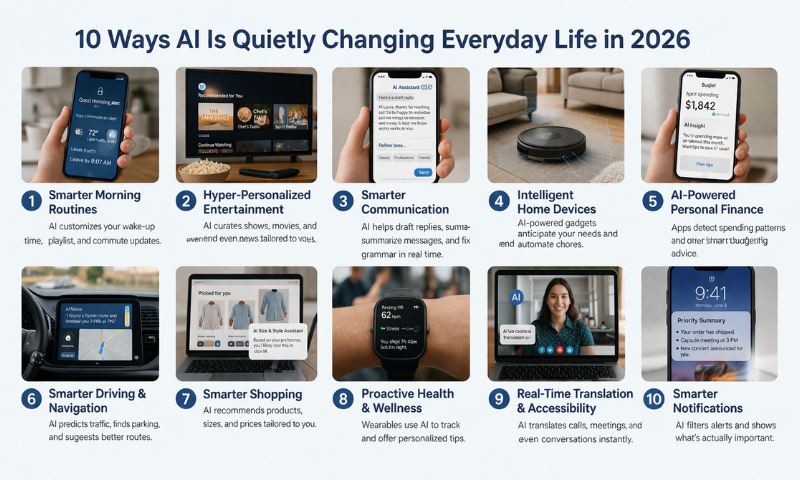
Most people think of artificial intelligence as something that happens in tech labs or Silicon Valley boardrooms. The reality in 2026 is far more personal. AI is changing daily life in ways most of us never asked for, never signed up for, and often do not even notice.
It is in the route your navigation app chose this morning. It is in the reason your streaming service knew exactly what to recommend at 9 PM. It is behind why your bank flagged that unusual transaction before you did. AI is not coming to change everyday life, it is already doing it, quietly, in the background of nearly every hour of your day.
Here are 10 of the most significant ways AI is changing daily life in 2026 — and what each one actually means for how you live.
AI in Everyday Life 2026: 10 Areas at a Glance
Here is a snapshot of every area covered in this article, how AI is showing up, and what it means for ordinary people:
| # | Life Area | How AI Shows Up | What It Changes for You | Noticed by Most? |
|---|---|---|---|---|
| 1 | Healthcare | AI diagnostics, symptom checkers | Earlier detection, faster diagnosis | Often invisible |
| 2 | Navigation & travel | Real-time traffic AI | Fewer delays, smarter routes | Yes — daily |
| 3 | Smart home | AI thermostats, cameras, and lights | Energy savings, security alerts | Partially |
| 4 | Work & productivity | AI writing, email, and scheduling | Hours saved weekly | Growing fast |
| 5 | Shopping & retail | AI recommendations, price matching | Smarter purchases, time saved | Yes — daily |
| 6 | Education | AI tutors, personalized learning | Students learn at their own pace | Growing fast |
| 7 | Mental health | AI therapy companions, mood tracking | Lower barrier to support | Often invisible |
| 8 | Finance & banking | Fraud detection, AI budgeting | Safer money, better decisions | Partially |
| 9 | Entertainment | Personalized recommendations | Content tailored to your taste | Yes — daily |
| 10 | Language & communication | Real-time translation, AI writing | Fewer barriers, faster comms | Growing fast |
1. Healthcare: AI Is Detecting Problems Before Doctors Can
One of the most significant ways AI is changing daily life involves healthcare, and most patients never see it happening. AI diagnostic systems are now embedded in the workflows of hospitals, clinics, and radiology departments, analyzing medical images with a speed and pattern-recognition capability that outpaces human review in many specific tasks.
AI-powered tools can now detect early-stage diabetic retinopathy from a retinal scan, flag suspicious lesions in mammograms, and identify irregular heart rhythms from smartwatch data. In 2026, several AI systems used in clinical settings have demonstrated accuracy rates in specific diagnostic tasks that match or exceed specialist-level performance.
At the consumer level, AI health apps on your phone are tracking sleep patterns, heart rate variability, and stress levels — and surfacing warnings before symptoms become problems. This is how AI is changing daily life without most people noticing: quietly working in the background to catch what used to get missed.
Must Read: 10 best AI marketing tools I’m using to get ahead in 2026
2. Navigation: Every Route You Take Is an AI Decision
When you open Google Maps or Waze and follow the suggested route, you are using one of the most widely experienced examples of how AI is changing everyday life. The route you see is not simply the shortest path, it is the output of an AI system processing real-time data from millions of devices, historical traffic patterns, accident reports, weather conditions, and road closures simultaneously.
In 2026, AI-powered autonomous taxis are operating in several US cities with no driver at all. Waymo vehicles in Phoenix and San Francisco are completing hundreds of thousands of rides per week, a development that felt futuristic three years ago and now competes with Uber for everyday commuters.
Even if you never step into a driverless car, the AI managing traffic signal timing in your city — increasingly common in major metros — is already shaping how long you sit at red lights.
3. Smart Homes: AI Is Managing Your House While You Sleep
The smart home of 2026 is not just responsive — it is predictive. AI-powered thermostats like Nest and Ecobee do not just follow your schedule; they learn it, anticipate it, and optimize energy usage around it automatically. Homeowners using AI-driven thermostats report average energy savings of 10 to 15 percent on heating and cooling bills.
AI security cameras in 2026 can distinguish between a delivery driver, a neighbor, a family member, and an unknown individual — sending alerts only for the last category. Smart lighting systems adjust brightness and color temperature based on time of day, occupancy, and even your typical sleep schedule.
These are all examples of AI changing daily life in ways most people attribute to “the thermostat” or “the camera app” without ever connecting them to artificial intelligence at all. The technology has become invisible precisely because it works.
4. Work and Productivity: AI Is Handling the Parts of Work Nobody Liked
Across offices, remote setups, and small businesses, AI is changing daily life at work by absorbing the time-consuming, repetitive tasks that used to fill entire afternoons. Email drafting, meeting summarization, scheduling, first-draft writing, data entry, and report generation are now AI-assisted tasks for a rapidly growing share of the workforce.
In 2026, an estimated 75% of small businesses are using or actively exploring AI tools in their operations. Customer service chatbots now handle the majority of first-contact customer queries without human involvement. A single employee with access to AI tools can now do work that previously required a small team.
This shift raises real questions about employment — but at the individual level, AI is changing how people work by giving back hours. Professionals who have integrated AI tools into their workflow report saving an average of 5 to 10 hours per week on tasks that used to be unavoidable.
5. Shopping: AI Knows What You Want Before You Search for It
Every time Amazon, Shopify, or any major e-commerce platform shows you a “you might also like” section, that is AI changing daily life in the most commercially refined way possible. Recommendation engines powered by machine learning analyze your browsing history, purchase patterns, time spent on product pages, and comparison behavior to surface items with a relevance that feels almost uncanny.
In physical retail, AI-driven inventory systems are reducing out-of-stock situations. AI pricing tools adjust product prices in real time based on demand, competitor pricing, and time of day — which is why the flight you checked this morning costs a different amount this afternoon.
For consumers, this means a shopping experience that is faster, more personalized, and harder to resist. For small businesses, AI-powered tools are leveling the playing field — allowing a one-person shop to run the kind of targeted, data-driven marketing that once required entire departments.
6. Education: AI Is Replacing the One-Size-Fits-All Classroom
Traditional education delivers the same lesson at the same pace to every student in the room. AI-powered learning platforms are dismantling this model, and it represents one of the most genuinely transformative ways AI is changing daily life for young people.
In 2026, AI tutoring tools can identify exactly where a student is struggling — not just which subject, but which specific concept within a subject — and adapt the lesson plan in real time. Students using AI-assisted learning tools are progressing at their own pace rather than the pace of the slowest or fastest student in the class.
For teachers, AI is changing daily life by handling the administrative burden: grading routine assignments, flagging at-risk students early, generating lesson plan drafts, and tracking learning outcomes across entire classrooms. This frees educators to do what AI cannot — build relationships, inspire curiosity, and teach the things that data cannot measure.
7. Mental Health: AI Is Lowering the Barrier to Getting Support
Mental health support has historically been limited by availability, cost, and stigma. AI is changing this dimension of daily life in a way that is both promising and worth watching carefully. AI-powered mental wellness apps like Woebot and Wysa offer cognitive behavioral therapy-based conversations available 24 hours a day at a fraction of the cost of traditional therapy.
These tools are not replacements for professional mental healthcare — and reputable ones are clear about this limitation. But for the millions of people who cannot access or afford therapy, or who simply need support at 2 AM when no human is available, AI mental health tools represent a meaningful new option.
In 2026, mood-tracking features built into Apple Watch and comparable wearables can identify patterns of stress, sleep disruption, and emotional volatility — giving users and, with consent, their healthcare providers, a more complete picture of mental wellbeing than self-reporting alone ever could.
8. Finance: AI Is Protecting Your Money Around the Clock
One of the most practically impactful ways AI is changing daily life in 2026 is financial security. AI fraud detection systems at major banks and payment processors now analyze thousands of variables per transaction in milliseconds — flagging suspicious activity with a speed and accuracy that human analysts could never match.
The average bank customer has interacted with AI fraud detection multiple times without knowing it — every time a suspicious transaction was blocked before it processed, or a notification arrived asking you to verify an unusual purchase. Visa and Mastercard report that AI fraud detection systems save billions in fraudulent transactions annually.
Beyond security, AI budgeting tools and financial planning apps are making it easier for ordinary people to manage money intelligently. Apps like Cleo, YNAB, and Copilot use AI to analyze spending patterns, predict upcoming expenses, and suggest realistic savings targets — making financial guidance accessible without a financial advisor.
9. Entertainment: The Algorithm Is the Gatekeeper Now
The entertainment you consume in 2026 is, to a remarkable degree, chosen for you by AI. Netflix, Spotify, YouTube, TikTok, and every major streaming platform use recommendation algorithms that analyze not just what you watch, but how long you watch, when you pause, what you rewatch, and what you skip.
This is how AI is changing daily life in ways that feel purely personal but are deeply engineered. The song that felt like it was made for you was surfaced by a machine learning model trained on the listening behavior of hundreds of millions of people who share your taste profile. The show you cannot stop watching was recommended because users with similar viewing patterns watched it within 30 minutes of finishing what you just finished.
This personalization creates genuine value — you discover things you genuinely love that you never would have found on your own. It also raises real questions about filter bubbles, algorithmic manipulation of attention, and the degree to which AI is shaping cultural consumption without transparency.
10. Language and Communication: AI Is Dissolving Language Barriers
Real-time AI translation is one of the quieter but more profound ways AI is changing daily life for billions of people. Google Translate now processes over 100 billion words per day. In 2026, earbuds with real-time translation are commercially available — you speak in English, the person across from you hears Mandarin, and the response comes back in English without any manual input.
For written communication, AI grammar and writing tools like Grammarly are used by over 30 million people daily, quietly improving the clarity and professionalism of billions of emails, messages, and documents. Non-native speakers of English — the dominant language of international business — are finding the playing field more level than at any point in history.
At the workplace level, AI transcription and translation tools are making global teams more functional. A meeting that includes participants from Brazil, Japan, Germany, and the US can now have real-time transcription in all four languages simultaneously — a capability that simply did not exist at scale three years ago.
Then vs Now: How AI Changed Daily Life in Just 3 Years
To understand the pace of change, here is how ordinary daily tasks looked in 2023 versus how AI is handling them in 2026:
| Daily Task | How It Worked in 2023 | How AI Changed It in 2026 |
|---|---|---|
| Doctor’s appointment | GP checks symptoms, refers to specialist | AI flags risk factors from wearable data before symptoms appear |
| Morning commute | Fixed route, manual traffic check | AI reroutes in real-time based on live data across millions of devices |
| Home heating | Manual thermostat adjustments | AI learns your schedule and optimizes automatically — saving 10–15% |
| Writing a work email | Blank page, typed from scratch | AI drafts in seconds; you edit tone and send |
| Online shopping | Browsed categories, searched manually | AI surfaces the right product before you search for it |
| Homework help | Textbook, search engine, parent help | AI tutor explains concepts at your child’s exact level, adapts in real time |
| Bank fraud | Discovered after the fact via statement | AI blocks the transaction before it processes — often in milliseconds |
| Watching TV | Browsed genres, picked manually | AI recommends the exact show you will want next, based on viewing behavior |
Frequently Asked Questions
Q. How is AI changing daily life in 2026?
AI is changing daily life in 2026 across virtually every domain — healthcare, education, finance, work, entertainment, and home management. Most of this change is invisible: AI fraud detection protects your bank account, AI navigation optimizes your commute, and AI recommendation engines shape what you watch and buy. The shift is less about robots and more about intelligent systems embedded in the tools you already use every day.
Q. Is AI in everyday life a good or bad thing?
Like most powerful technologies, AI in everyday life is both. On the positive side, it detects disease earlier, saves time, reduces fraud, personalizes education, and makes financial guidance accessible. On the concerning side, it raises questions about privacy, job displacement, algorithmic bias, and the degree to which attention and choice are being quietly engineered. Both realities are true simultaneously, and the more aware people are of both, the better positioned they are to navigate this shift.
Q. Do most people know how much AI affects their daily life?
No — and this is one of the defining characteristics of how AI is changing everyday life in 2026. Most AI applications are invisible by design. You do not see the fraud detection algorithm. You do not see the traffic model behind your navigation. You feel the recommendation but rarely think about the machine learning model producing it. Surveys consistently show that people underestimate the number of times they interact with AI daily — the real number is typically in the dozens.
Q. Is AI taking over jobs in everyday industries?
AI is automating specific tasks within many jobs rather than eliminating entire roles wholesale — at least for now. Customer service chatbots handle routine first-contact queries. AI writing tools draft routine communications. AI scheduling tools manage calendars. In each case, human judgment, creativity, and relationship-building remain essential. The bigger risk is to workers who perform primarily routine, repetitive cognitive tasks without adapting to use AI tools themselves.
Q. How is AI changing healthcare in everyday life?
AI is changing healthcare by enabling earlier detection, faster diagnosis, and more personalized treatment. Wearable devices now monitor health data continuously and flag anomalies before symptoms become serious. In clinical settings, AI diagnostic tools assist radiologists, pathologists, and general practitioners with pattern recognition that would take humans significantly longer. The long-term impact is a shift from reactive medicine — treating illness after it occurs — to predictive medicine that intervenes earlier.
Q. What are the biggest concerns about AI in daily life?
The most significant concerns about how AI is changing daily life include data privacy (AI systems require vast amounts of personal data to function), algorithmic bias (AI trained on biased data produces biased outcomes), job displacement (automation reducing demand for certain types of human work), and the erosion of attention and choice through highly optimized recommendation systems. These are not hypothetical future risks — they are active challenges that researchers, regulators, and individuals are navigating right now.
Final Thought: The Quietest Revolution Is the Most Consequential
The most important thing to understand about how AI is changing daily life in 2026 is that it does not announce itself. It does not arrive with flashing lights or dramatic demonstrations. It arrives in the form of a route that saved you 12 minutes, a cancer screening that caught something early, a transaction that was blocked before you even noticed it, and a song recommendation that made your morning better.
This quiet quality is both what makes AI’s integration into everyday life so seamless and what makes it worth paying attention to. The less visible a technology is, the less scrutiny it receives — and AI is making consequential decisions about your health, your finances, your education, and your attention at a scale that deserves more awareness than most people currently give it.
Understanding how AI is changing your daily life is not about fear. It is about being an informed participant in a shift that is already well underway.


Leave a Reply