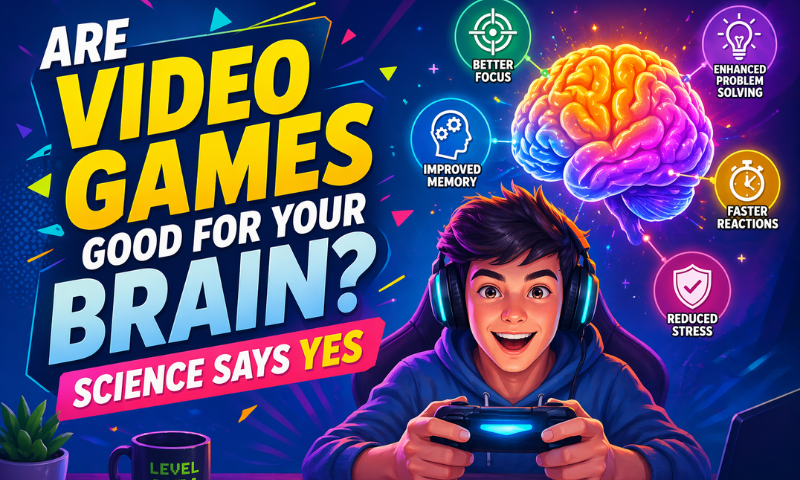
Are video games good for your brain?
Yes — peer-reviewed research from Oxford, Max Planck, and the University of Rochester documents real cognitive benefits including improved spatial reasoning, faster visual processing, stronger working memory, better problem-solving, and slower cognitive decline in older adults. Benefits are most consistent with moderate, regular play.
✅ Peer-Reviewed Science
🧠 7 Cognitive Benefits
⚠️ Moderation Matters
For decades, the cultural conversation around video games defaulted to one position: they are a waste of time at best, actively harmful at worst. Parents worried. Teachers sighed. Headlines warned about addiction and violence.
They were largely wrong. The evidence that video games are good for your brain is not fringe science. It comes from peer-reviewed studies at major research institutions using brain imaging, randomised controlled trials, and longitudinal data spanning years. This article covers 7 of the most well-supported cognitive benefits, the types of games linked to each, and an honest breakdown of what the research actually says.
📊
Video Games Good for the Brain: 10 Benefits at a Glance
| Brain Benefit |
What It Means |
Best Game Types |
Evidence |
| Spatial reasoning |
Mentally rotate, navigate & visualise 3D objects |
Action, open-world, puzzle |
Very strong |
| Reaction time |
Quicker visual stimuli & motor response |
Action, FPS, sports |
Strong |
| Working memory |
Hold & manipulate more info simultaneously |
Strategy, puzzle, RPG |
Strong |
| Problem-solving |
Analyse situations, generate creative solutions |
RPG, strategy, puzzle |
Strong |
| Attention & focus |
Sustain concentration, filter distractions |
Action, RTS |
Mod–strong |
| Hand-eye coordination |
Visual input tightly coupled to fine motor response |
Action, sports, rhythm |
Very strong |
| Cognitive decline |
Slower deterioration in older adults |
Puzzle, strategy |
Growing |
| Emotional regulation |
Stress tolerance, frustration recovery |
Most genres |
Emerging |
| Social cognition |
Cooperation, theory of mind, social dynamics |
Multiplayer, co-op |
Moderate |
💡 Key Note
Most positive findings come from moderate, regular play — not marathon sessions. Video games are good for your brain within a healthy pattern of use, not despite an unhealthy one.
🧠
7 Science-Backed Ways Video Games Are Good for Your Brain
1. Video Games Improve Spatial Reasoning and Navigation
Spatial reasoning is one of the cognitive skills most consistently linked to video games being good for your brain. A landmark study by researchers at the Max Planck Institute for Human Development in Berlin found that adults who played Super Mario 64 for 30 minutes per day over two months showed measurable increases in grey matter in the hippocampus, right prefrontal cortex, and cerebellum — regions associated with spatial navigation, strategic planning, and fine motor skills.
This matters beyond gaming because spatial reasoning is a significant predictor of performance in STEM fields. Research from the University of Illinois found that video game training produced improvements that transferred to other untrained spatial tasks — a finding that directly supports the long-term value of gaming on cognition.
Best game typesOpen-world, 3D platformers, first-person exploration
Research institutionMax Planck Institute, Berlin
Key findingBrain volume increases after just 2 months of daily gaming
2. Action Games Sharpen Attention and Visual Processing
One of the most replicated findings in cognitive science is that action game players demonstrate superior attentional abilities — and these differences show up in standardised lab tests, not just self-report. Research by Dr. Daphne Bavelier at the University of Rochester found action video game players were significantly better at tracking multiple objects simultaneously, detecting subtle visual changes, and filtering irrelevant information.
Crucially, Bavelier’s team found these advantages were trainable — not just pre-existing traits. When non-gamers were assigned to play action games in controlled studies, their attentional performance improved measurably. This makes video games one of the only consumer activities proven to produce genuine, transferable improvements in visual attention.
📊 Action gamers show up to 25% faster reaction times on visual attention tasks vs non-gamers (Bavelier et al., University of Rochester)
3. Strategy and RPG Games Build Problem-Solving Skills
A longitudinal study published in PLOS ONE found that teenagers who spent more time playing strategy video games demonstrated better problem-solving skills and higher academic achievement — with the relationship persisting even after controlling for other variables. Games like Civilisation, StarCraft, and complex RPGs require players to hold multiple variables in mind simultaneously, anticipate consequences several moves ahead, and revise strategies when initial approaches fail.
These cognitive demands are structurally similar to real-world professional problem-solving — which explains why the transfer effects here are among the most consistent in the gaming cognition research literature. Proving, once again, that video games are good for your brain in ways that directly apply outside the screen.
📈 Strategic gaming linked to higher GPA and better problem-solving test scores, even controlling for other factors (PLOS ONE longitudinal study)
4. Gaming Strengthens Working Memory
Working memory — the ability to hold and actively manipulate information in mind over short periods — is one of the most important cognitive capacities for learning and daily functioning. Research from the University of Geneva found that children who played action video games showed enhanced working memory performance compared to non-gamers, with improvements particularly pronounced in tasks requiring rapid updating of visual information.
For older adults, puzzle and strategy games have shown measurable ability to maintain working memory capacity over time — with several studies finding regular gaming associated with slower decline in this domain compared to non-gaming controls.
For childrenAction game players outperform non-gamers on visual working memory tasks
For older adultsRegular puzzle gaming associated with maintained memory past age 60
5. Games Build Exceptional Hand-Eye Coordination
A study at Beth Israel Medical Centre found that laparoscopic surgeons who played video games for more than three hours per week made 37% fewer errors and completed procedures 27% faster than non-gaming peers. The fine motor precision developed through gaming transfers directly to skilled manual work — training exactly the speed and precision that complex procedures demand.
This remains one of the most robust transfer effects in the entire gaming cognition literature and has influenced medical training discussions at multiple major institutions — a powerful real-world proof that video games are good for your brain and body simultaneously.
🏥 Surgeons gaming 3+ hrs/week: 37% fewer errors, 27% faster procedures (Beth Israel Medical Centre)
6. Gaming Supports Emotional Regulation and Stress Relief
A study from the University of Oxford found that playing games for around one hour per day was associated with higher wellbeing scores in adolescents compared to both non-gamers and excessive gamers alike. Two distinct mechanisms explain this: first, the fail-and-retry loop of difficult games trains frustration tolerance in a low-stakes context. Second, immersive games provide genuine psychological distance from daily stressors — functioning similarly to reading or physical exercise.
⚠️ The key qualifier: benefits are associated with moderate, intentional play — not passive or compulsive gaming. The dose determines whether video games are good for your brain or not.
7. Games Protect Against Age-Related Cognitive Decline
A study published in Nature found that a purpose-designed video game (NeuroRacer) improved multitasking and attentional control in adults over 60 to levels comparable to untrained adults in their 20s — with the benefits persisting six months after training ended. Several broader studies have found that older adults who game regularly show significantly slower rates of cognitive decline than non-gaming peers, with puzzle and strategy games particularly associated with maintained performance on memory and executive function tests.
🔬 Nature study: NeuroRacer raised over-60s multitasking to the level of untrained 20-year-olds — effects lasted 6 months post-training
🎮
Which Games Are Best for Your Brain? Genre-by-Genre Guide
Not all games produce the same cognitive benefits. Here is a complete breakdown of what different game genres actually do to your brain:
| Genre |
Primary Brain Benefits |
Example Titles |
Best For |
| Action / FPS |
Reaction time, spatial awareness, selective attention |
Call of Duty, Halo, Doom |
Focus, visual speed |
| Strategy RTS/TBS |
Planning, multitasking, working memory, problem-solving |
StarCraft, Civilisation, XCOM |
Executive function |
| Puzzle |
Logical reasoning, working memory, pattern recognition |
Portal, Tetris, The Witness |
Cognitive flexibility |
| RPG |
Narrative thinking, decision-making, empathy, memory |
The Witcher, Baldur’s Gate, Skyrim |
Complex reasoning |
| Open world |
Spatial navigation, curiosity-driven learning, creativity |
Minecraft, No Man’s Sky, Zelda |
Spatial cognition |
| Multiplayer / co-op |
Social cognition, communication, teamwork, leadership |
Overcooked, Destiny, Sea of Thieves |
Social skills |
| Sports / racing |
Hand-eye coordination, reaction time, motor precision |
FIFA, Gran Turismo, Rocket League |
Motor skills |
| Rhythm / music |
Timing, motor sequencing, auditory processing |
Beat Sabre, Guitar Hero, Thumper |
Rhythmic cognition |
⚖️
The Honest Caveat: Video Games Are Good for Your Brain — With Balance
The scientific evidence that video games are good for your brain is genuine and growing. But the research also makes clear that the benefits are tied to moderate, intentional play — not compulsive or excessive use. The same studies that find cognitive benefits consistently find excessive, uncontrolled gaming associated with sleep disruption, reduced physical activity, and attentional difficulties.
- ✔For cognitive benefits: 1–2 hours of engaged, intentional gaming per session produces the most consistent positive outcomes
- ✔For sleep: Avoid gaming in the hour before bed — stimulation and blue light disrupts sleep onset
- ✔For balance: Gaming works best alongside other mentally engaging activities, not as the sole source of cognitive stimulation
- ✔For children: Research benefits apply to age-appropriate content — genre and content matter significantly for younger players
- ⚠Warning sign: If gaming consistently crowds out sleep, physical activity, real-world relationships, or responsibilities — it has moved beyond the zone where benefits apply
❓
Frequently Asked Questions
Q
Are video games actually good for your brain?
Yes. Peer-reviewed studies at Oxford, Max Planck, and Rochester document benefits including improved spatial reasoning, faster visual processing, stronger working memory, better problem-solving, enhanced hand-eye coordination, and slower cognitive decline. Benefits are most consistent with moderate, regular play.
Q
What type of video games are best for brain development?
Action games improve reaction time and visual attention. Strategy games build planning and working memory. Puzzle games train logical reasoning. Open-world games develop spatial navigation. Strategy and puzzle games have the strongest overall evidence base for cognitive development.
Q
Do video games improve memory?
Yes — particularly working memory. Action game players consistently outperform non-gamers on visual working memory tasks. For older adults, regular puzzle and strategy gaming is associated with maintained memory function over time.
Q
How long should you play video games to get brain benefits?
Research most consistently links benefits to 1–2 hours of engaged gaming per session, several times per week. The Oxford study found around one hour of daily gaming produced the best wellbeing outcomes — with diminishing returns at higher daily hours.
Q
Are video games good for older adults’ brains?
Yes. A Nature study found NeuroRacer raised multitasking in adults over 60 to the level of untrained 20-year-olds, with benefits lasting 6 months post-training. Puzzle and strategy games are most consistently linked to maintained cognitive function in older populations.
Q
Do video games help with stress?
Yes, in moderation. Oxford research found moderate gaming (~1 hour daily) associated with higher wellbeing. The fail-retry structure builds frustration tolerance while immersive gameplay provides genuine psychological distance from daily stressors.
Q
Can video games improve hand-eye coordination?
Yes — surgeons gaming 3+ hours per week made 37% fewer errors and completed procedures 27% faster than non-gaming peers (Beth Israel Medical Centre). The motor precision developed through gaming transfers directly to real-world skilled work.
Q
Can video games help with focus and attention?
Yes. Dr Daphne Bavelier’s research found action game players show superior performance on visual attention tasks — and these improvements were trainable. Non-gamers assigned to action games improved measurably in controlled studies.
Disclaimer: This article is for informational and educational purposes only. It does not constitute medical or psychological advice. Always balance gaming with physical activity, sleep, and real-world social connection for overall wellbeing. If you have concerns about gaming habits or mental health, please consult a qualified professional.





Leave a Reply