Quick Answer
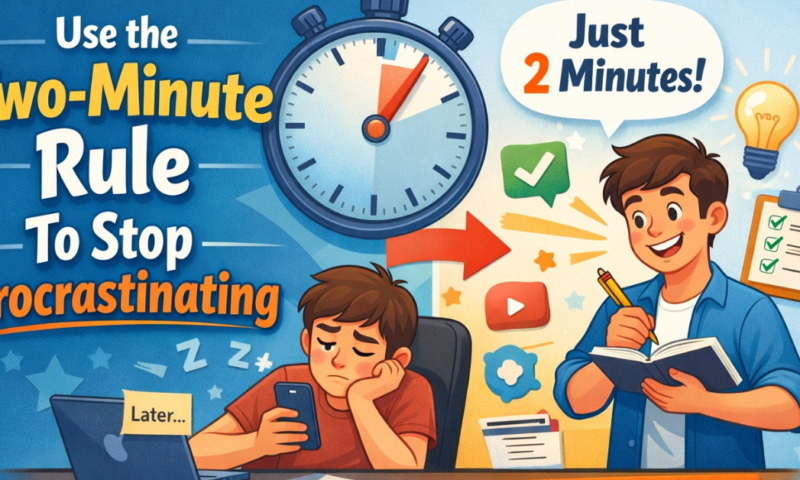
How do you stop procrastinating? Procrastination is not a laziness or time management problem — it is an emotion regulation problem. You avoid tasks because of how they make you feel, not because you lack discipline. The 2-minute rule addresses this directly: if a task takes under 2 minutes, do it now. For bigger tasks, scale them down to a 2-minute entry point to bypass the emotional resistance that causes avoidance. Motivation follows action — it does not precede it.
What you’ll learn:
✓ Brain science
✓ 2-Minute Rule
✓ 2025 Research
✓ 20 Real Examples
You have a task in front of you. You know you need to do it. You know putting it off will cost you — time, stress, sleep, sometimes money. And yet you do it anyway. Another tab opens. The coffee gets refilled. The messages get checked. And somehow the task sits exactly where you left it.
This is not laziness. Research consistently shows that procrastination is not a time management problem — it is an emotion regulation problem. You are not avoiding the task. You are avoiding the feeling the task produces. That distinction changes everything about how to stop procrastinating effectively.
🧠
Why You Procrastinate: The Brain Science Nobody Talks About
Understanding how to stop procrastinating starts with understanding what is actually happening in your brain when you avoid a task. It is not a character flaw — it is a neurological conflict between two competing systems.
The Emotional Brain
Limbic System
Prioritises immediate comfort. When a task feels boring, overwhelming, or anxiety-inducing, it treats the task as a threat and steers you toward relief — your phone, social media, anything that produces immediate positive sensation.
The Rational Brain
Prefrontal Cortex
Knows the task needs doing. Understands the long-term cost of delay. Wants to act. But it is the weaker system in the short term — when your emotional brain screams “not now,” your rational brain rarely wins.
🔬 Research Finding
Procrastination is an emotion-focused coping strategy
As Dr. Tim Pychyl, a leading procrastination researcher at Carleton University, explains: procrastination is primarily a way to temporarily escape the discomfort a task triggers. The task is not the problem. The feeling the task creates is. This is why willpower-based approaches consistently fail — they target the wrong thing entirely.
📊
What the Research Actually Shows
Before looking at how to stop procrastinating, here is the full picture of how widespread and costly it actually is:
| Finding |
Statistic |
Source |
| Adults who procrastinate chronically |
~20% |
Psychological research |
| Students who procrastinate regularly |
~70% |
Multiple university studies |
| Procrastination with significant heritability |
~46% |
Twin study, Psychological Science |
| Procrastinators reporting higher stress levels |
Significantly higher |
APS review, 20 years of studies |
| People who improved at starting tasks (2-min exercise) |
Statistically significant |
UC Santa Barbara, BMC Psychology 2025 |
| Habits scaled to 2-min version that stuck long-term |
More consistent than full habits |
James Clear, Atomic Habits |
| 2-min rule tasks that continued beyond 2 minutes |
Majority of the time |
Newton’s Law — objects in motion |
⏱
What Is the 2-Minute Rule — and Where It Comes From
The 2-minute rule is one of the most cited frameworks for how to stop procrastinating — but most people only know half of it. It actually has two distinct versions from two different sources. Understanding both makes it significantly more powerful.
Version 1
David Allen
Getting Things Done
The Task Rule: If a task takes less than two minutes to complete, do it immediately rather than deferring it.
The mental overhead of writing it down, remembering it, reviewing it later, and deciding when to do it takes more time and energy than the task itself. Do it now. Close the loop instantly.
Examples: Replying to a short email · filing one doc · sending a confirmation · taking out the bin
Version 2
James Clear
Atomic Habits
The Habit Rule: When starting a new habit, scale it down to a version that takes less than two minutes to begin.
The goal is not to complete the habit in two minutes — it is to eliminate the resistance to starting it. Once started, the barrier to continuing is far lower than the barrier to beginning.
Example: “Run 5km” → “Put on running shoes and step outside”
How to Scale Any Habit Down to 2 Minutes
| Full Habit (what you want to do) |
2-Minute Entry Point (what you commit to) |
| Read 30 minutes before bed |
Read one page |
| Do 30 minutes of yoga |
Unroll the yoga mat |
| Write 1,000 words |
Open the document and write one sentence |
| Go for a 5km run |
Put on running shoes and step outside |
| Meditate for 10 minutes |
Sit in the meditation chair — nothing else required yet |
| Study for an exam for 1 hour |
Open the textbook to the right chapter |
⚡
Why the 2-Minute Rule Works: 4 Psychology Principles
The 2-minute rule is not just a productivity trick — it has a solid psychological and neuroscientific explanation for why it helps people stop procrastinating. Here are the four mechanisms behind it:
🚦
Solves the Starting Line Problem
A 2025 UC Santa Barbara study found that most procrastination lives in the tiny pause between intention and action. A 2-minute entry point eliminates that pause by making the first step feel trivially small.
🛡️
Bypasses the Emotional Brain’s Veto
The limbic system does not register “two minutes” as threatening. It is too small to trigger the avoidance response. You sidestep the veto before it can fire — which is why the method works even when willpower fails.
🎯
Produces Immediate Dopamine
Completing even a tiny task produces a small dopamine hit — the brain’s reward signal. This micro-surge of satisfaction makes the next action slightly easier. Early wins build momentum from the very first action.
🔁
Exploits the Zeigarnik Effect
Psychologist Bluma Zeigarnik found that unfinished tasks occupy more cognitive space than completed ones. Once you start — even briefly — the brain keeps returning to the task. Starting is often all you need to guarantee continuation.
📄 2025 Research — UC Santa Barbara, BMC Psychology
“Most interventions aim to change who we are long-term — but procrastination happens in the moment”
A large-scale 2025 study published in BMC Psychology by researchers at UC Santa Barbara identified what they called “the starting line problem” — the tiny psychological pause between intention and action where most procrastination lives.
Their research found that a brief two-minute reflection exercise that lowered emotional resistance and broke the task into a smaller first step significantly increased the likelihood of people actually starting. Pairing that first step with a small self-chosen reward made the effect significantly stronger.
✓
How to Apply the 2-Minute Rule to Stop Procrastinating Today
Here is a practical, step-by-step system for using the 2-minute rule — both on quick tasks and on bigger goals you have been avoiding.
1
When processing tasks — apply Allen’s rule immediately
Every time you encounter a new task — an email, a request, a thought about something you need to do — ask one question: does this take less than two minutes? If yes, do it right now. Do not write it down, do not schedule it, do not defer it. Do it now and eliminate it from your cognitive load entirely.
2
For bigger tasks — scale to the 2-minute entry point
For anything larger that you have been avoiding, identify the smallest possible starting action — the one that takes two minutes or less. Not the full task. Just the first move. Avoiding the gym? Commit to putting on your gym clothes. Avoiding a work project? Open the document and write one bullet point. In most cases, once you complete the entry action, momentum takes over naturally.
3
Pair with a small reward (the UC Santa Barbara finding)
The 2025 study found that pairing a small first step with a small self-chosen reward made the motivation boost “significantly stronger.” The reward does not need to be large — a walk, a coffee, a five-minute phone scroll, or simply marking something done. Sequence: commit to two minutes → complete the entry action → take your small reward → decide whether to continue. Most of the time, you will continue.
4
Name what you are feeling (affect labelling)
Before you start, simply name the emotion the task produces: “I feel anxious about this” or “This feels boring” or “I’m afraid it will go badly.” Neuroscience research shows that naming an emotion reduces its intensity by activating the prefrontal cortex — the rational brain — which is exactly what you need to override the limbic system’s avoidance response. This takes about ten seconds and meaningfully reduces emotional resistance before you begin.
⚖
2-Minute Rule vs Other Procrastination Methods
There are many techniques for how to stop procrastinating. Here is an honest comparison of how the 2-minute rule stacks up against the most popular alternatives:
| Method |
Willpower Needed |
Science-Backed |
Works For Habits |
Best For |
| 2-Minute Rule |
Minimal |
✓ Strong |
✓ Yes |
Any task or habit, any time |
| Pomodoro Technique |
Moderate |
✓ Good |
✓ Yes |
Deep focused work sessions |
| Eat the Frog |
High |
△ Partial |
△ Limited |
Known priority tasks (motivated days) |
| Time Blocking |
Moderate |
✓ Good |
✓ Yes |
Scheduled deep work |
| Accountability Partner |
Low (once set up) |
✓ Strong |
✓ Yes |
Long-term habit change |
| Pure Willpower |
Very High |
✗ Unreliable |
✗ Inconsistent |
Motivated days only (not a system) |
20
The 2-Minute Rule in Real Life: 20 Examples Across Work, Home and Habits
Here are specific, ready-to-use applications of the 2-minute rule across the most common areas where people struggle with procrastination. Find yours and use it today:
💼 At Work
- →Avoiding a report? Open the doc and type the first heading
- →Dreading a difficult email? Write just the subject line
- →Overwhelmed by inbox? Reply to just one — the shortest one
- →Postponing a project? Create one card or bullet in Notion
- →Delaying a presentation? Add one title slide with today’s date
- →Avoiding a phone call? Find the number and press dial
🏠 At Home
- →Dishes piling up? Wash just one plate immediately after using it
- →Messy desk? Put one item back in its place
- →Neglected laundry? Just open the machine and load it
- →Cluttered drawer? Remove one item you do not need
- →Missed appointment? Open your calendar and find a slot now
🎯 Habits & Goals
- →Want to exercise? Put on your gym clothes — nothing more
- →Want to read more? Read exactly one page tonight
- →Want to journal? Write one sentence about right now
- →Learning a language? Open Duolingo and complete one lesson
- →Want to meditate? Sit quietly for two minutes with no phone
?
Frequently Asked Questions
Q
What is the 2-minute rule for procrastination?
The 2-minute rule addresses procrastination in two ways. David Allen’s version states that any task taking less than two minutes should be done immediately rather than deferred. James Clear’s version states that when building a new habit, scale it down to a version that takes less than two minutes to start — removing the activation energy barrier that causes avoidance in the first place.
Q
Why do people procrastinate even on tasks they care about?
Procrastination is primarily an emotion regulation problem, not a time management failure. People delay tasks because those tasks trigger uncomfortable emotions — anxiety, boredom, fear of failure, or perfectionism. Importantly, people often procrastinate most on tasks they care about most, because higher stakes create higher emotional risk. The brain responds to the discomfort, not the importance of the task.
Q
Does the 2-minute rule actually work?
Yes — and there is now direct research supporting it. A 2025 large-scale study published in BMC Psychology by UC Santa Barbara researchers found that brief two-minute interventions that reduce emotional resistance and break tasks into smaller first steps significantly increase the likelihood of starting. This supports both Allen’s original insight and Clear’s habit-formation application of the same principle.
Q
What if the 2-minute rule feels too simple?
That reaction is common — and is precisely why the rule works. The emotional brain does not resist tasks that feel small. Its avoidance response is calibrated to the perceived scale of the challenge. By making the task feel trivially small, you bypass the very mechanism that was blocking you. Simple does not mean ineffective — it means the psychological friction has been removed.
Q
How is procrastination different from laziness?
Procrastination and laziness are fundamentally different. Laziness is a general disinterest in activity. Procrastination is the active, often distressing avoidance of a specific task — frequently accompanied by guilt and the genuine intention to do it “later.” Most procrastinators want to complete the task and feel real discomfort from not doing so. Research links procrastination to emotional regulation difficulties, not effort capacity.
Q
What if I do 2 minutes and still cannot continue?
That is still a win. You have broken the avoidance pattern, created a small momentum, and — through the Zeigarnik effect — made it harder for your brain to fully disengage from the task. Tomorrow’s two-minute start will be easier than today’s. The goal is not to force a marathon session. It is to make starting a normal, low-resistance event in your daily life.
⏱️
You Do Not Need to Feel Ready
The most persistent myth about how to stop procrastinating is that you need to feel motivated first. You do not. Motivation follows action — it does not precede it. Waiting to feel ready is itself procrastination.
The 2-minute rule does not ask you to feel ready. It does not ask you to want to do the task, be excited about it, or believe you will do it perfectly. It asks for two minutes — which is the one thing nobody genuinely cannot spare.
What task have you been putting off? Name it. Name how it makes you feel. Then do two minutes of it — right now, before you close this tab.



Leave a Reply